Book club 2024!!

Down on the Homefront
  • Home
  • Blog
  • Gallery
  • About
  • Contact
  • Capstone
  • Book Club 2024
  • YouTube
  • Navigation

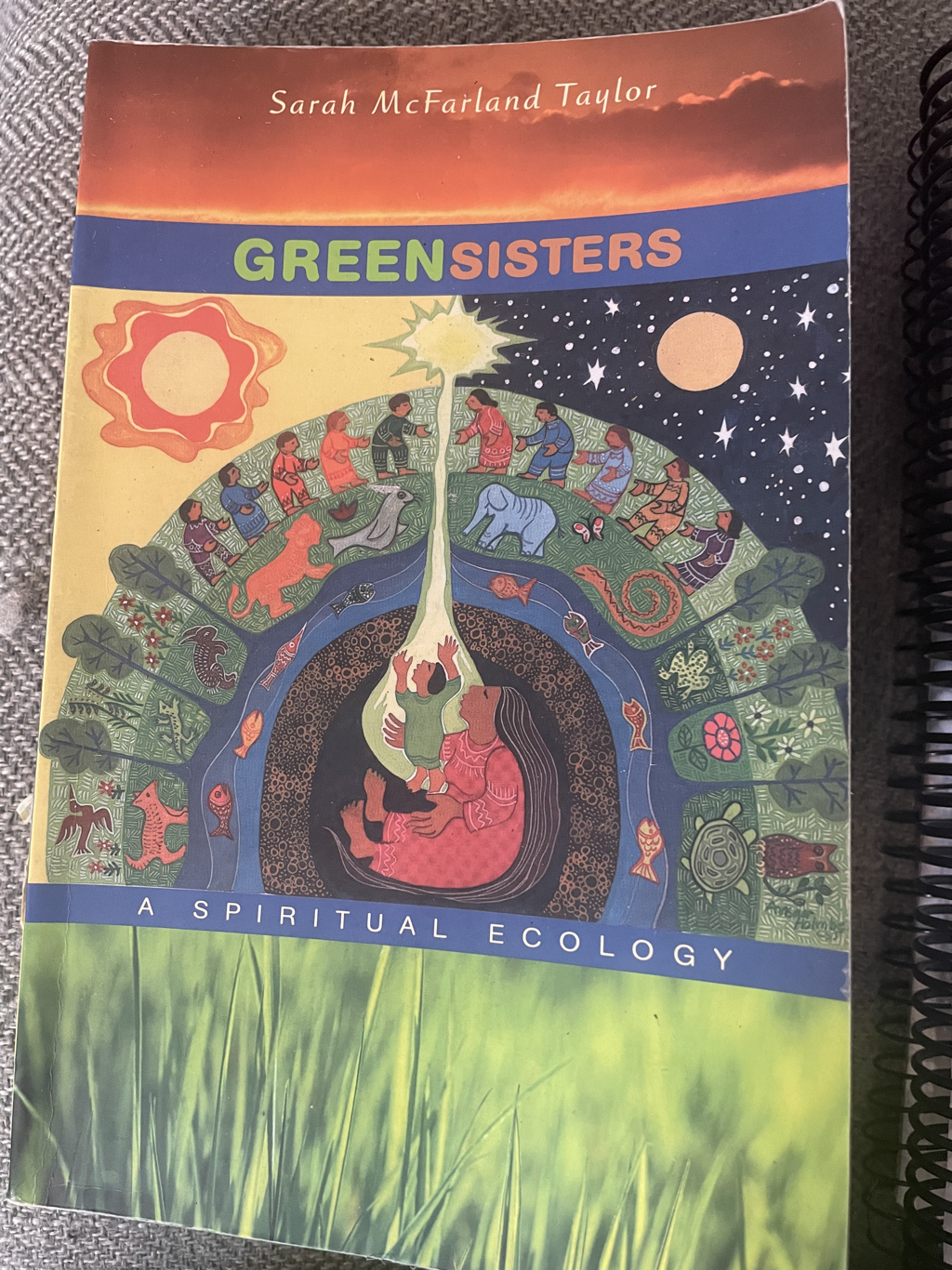
Green sisters: a spiritual ecology by Sarah McFarland Taylor

2/16/2024

0 Comments

 
Picture
Green sisters 1
Today, I bring to you the start of a new book read on this blog, Green Sisters: A Spiritual Ecology, By Sarah McFarland Taylor. This book is an ethnography, or a cultural study, of environmentalist nuns in North America.
The author prefaces her book with a little bit of background and understanding of “what is a green sister?” What she colloquially calls these environmentalist nuns (and the term which I will henceforth be using), as well as a little bit about related terminology.
She talks about this being a counter cultural movement, and clarifies she does not speak for the sisters, but through her own lense. Taylor clarified one term specifically that caught my eye: Lived religion—a term I feel like I’ve been searching for ever since I started exploring paganism. ‘Hold up!’ You say, as I ramble on about paganism ‘this book is about the Green Sisters Catholicism!’ Yes, I know this. However, I feel my expression of paganism reaches out into Christian tradition and by relation Catholicism, as well as its roots in all abrahamic religion. Paganism has a lot of historical intersections with these traditions in different forms. They feed off of each other and I feel like the intersections in the Ven diagram between abrahamic religion, paganism, and earthen traditions has a lot of overlap. That is to say, this is how I’m using this book to apply these principles within my own value system.
Further, Taylor writes about her writing practices, including one I found particularly useful in writing nonfiction—Interlocking sources. This is the idea that every proposition should be backed up by interlocking sources. It just really helps me in thinking how I should be organizing my writing for my own book project, Holometaboly (check the Capstone tab for more!) Specific to both Holometaboly and Green Sisters are the ways in which we study gender and spirituality. Taylor explains, “In the challenges I faced in my own research, it quickly became evident that history and ethnography need one another, and that both benefit from an analysis of gender as it relates to religion and culture” (xii). Taylor transcends the stereotypes of “women religious” by quoting them directly in a quote echoed by many, “‘Anonymous’ was often a woman”. This, to me, was empowering, and I felt ready to spiritually arm myself with the knowings of these people. “To find material about women’s religious lives, often one must pick through the refuse of history” (Xiv) what else is in the refuse of history? What treasures lie asleep…


Taylor writes of the movement of the green sisters to be “a new blade rising” in Catholicism. Freshness in the face of modern Catholicism, and not stained by and preconceptions or stereotypes of The Catholic Church. Instead, Taylor clarifies, they are a new glimmer of hope, that has grown into points of light across the catholic clergywomen (in North America specifically.)
To introduce her book, she walks through the premises of the chapters. Taylor further writes of her book that contemporary historical religious ethnography must be looked in much the same way “as a biogeographer would” (more charmed down, a “good” farmer, an ecologically holistic Wendell-Berry-type farmer). I was thrilled to see Taylor then quote from Father Thomas Berry, a passionist priest and writer. She highlights his declaration of a need for an ecological ethos and a “functional cosmology”. There is a dance in her text of the relationship between cosmology and ontology, but I, personally, feel its center of gravity lies in “place”. Cosmology being our overarching cosmic niche and ontology being the nature of our individual beings.
As I read all of this, I felt just like I was reading a book meant for me, combining thoughts from all my favorite theologians. Taylor writes about Father Thomas Berry’s insistence upon the shared understanding and functional unity of religion, science and nature, and humanity. The Green Sisters, Taylor writes, brings this theory full circle with their actions, “live[ing] in true communion with creation” (12).
Taylor writes, “that Green sisters have adopted the image of the rhizome as a metaphor for their movement poses a striking contrast to the centralized, hierarchical “taproot” power of the institutional church” (Taylor 18) moreover, what she writes of the movement of the green sisters, while divinely feminine, transcends traditional gender roles. Metaphor, here is brought to life, with an emphasis of just that, the inherent animation of the world. Detailing these actions, Taylor writes, “ecological sustainability has become a part of daily spiritual practice, and sustainable ways of life have become a form of spiritual discipline” (12). But I think the insight that “brought it all home” to me, was reinhabitation. Taylor equates this with stability. Home is something I’ve thought about a lot over my life—moving across states as a young child to my Dad’s family’s hometown, home as the place I spent the most time versus where I slept, the breakup of our nuclear family and the sale of our home and gradually building a new home of emotional and physical safety, and now finding home in the hearts of those whom I love. My family still questions where our true home is. In the Wendell Berry Farming Program I studied homecoming quite thoroughly, and being or becoming “native to a place”. I imagine, as one would guess about me, one day moving to my future homestead with my partner and perhaps even eventually some of our family members, and you know? I don’t really see why we can’t have multiple homes. The house we live in, our hometowns, but also more simply, our bodies. We must reconnect ourselves to our bodies, reinhabit them, and (I believe) rewild them. Realize our niche in the natural world, and reinhabit it. Regain our traditions and find new ways to live in harmony with our home, the earth, and our family members, the earthlings.


I hope you have enjoyed today’s deep read! Here’s to a great book ahead of us, with lots to learn. Don’t worry if you don’t have the book/don’t have the time or even want to read the book, I’ll be here to synthesize the information and divine some of its wisdom for us.
Blessings!
0 Comments


Leave a Reply.

    Welcome to book club 2023! This year I have selected 14 books (one for each month, an extra, and a partially read one I will finish) to review for you as I read through them. Feel free to read along if you’d like and leave all the comments you’d like whether you’re reading along or just reading my posts! Stay tuned for extras and fun! Blessings, August Lee

    Books

    Sacred Actions by Dana O’Driscoll
    How to be a Good Creature by ash Montgomery
    Cord Magic by Brandy Williams
    Finding the Mother Tree by Suzanne Simard
    The Botany of Desire by Michael Pollan
    Beauty by Natalie Carnes
    World of Wonders by Aimee Nezuhkumatathil
    ​The Wisdom of Birch, Oak, and Yew by Penny Billington
    Sacred Agriculture: The Alchemy of Biodynamics by Dennis Klocek
    American Georgics edited by Hagenstein, Gregg, and Donahue
    Maddaddam by Margaret Atwoodd
    Our Only World by Wendell Berry
    The Mushroom at the End of the World by Anna Tsing
    Silent Spring by Rachel Carson
    2023 Blogs
    ​- Feb 4 2023 Sacred Actions section 1
    - Feb 6 2023 The Spinners Book of Yarn Designs, BC Extra

    RSS Feed


Picture
Proudly powered by Weebly
  • Home
  • Blog
  • Gallery
  • About
  • Contact
  • Capstone
  • Book Club 2024
  • YouTube
  • Navigation